Real Person. Real ID.
Real Match. Done.
Identity verification without enterprise contracts or a CRM full of your users' personal data. Every verification generates a blockchain-anchored certificate proving you made reasonable effort. Send a link, get a result, keep the receipt.
Seeking Beta Testers
Ad-Hoc Verify is fully built and nearly ready for production — but we need real users to put it through its paces. Sign up, create a verification request, and try the full flow end to end. Everything is completely free during beta, no credit card required, no strings attached. Your feedback will directly shape the final product.
See It In Action
Identity verification, simplified.
Ad-Hoc Verify is a browser-based identity verification service. You send someone a link. They scan their driver's license and take a selfie. We compare the face on the ID to the face in the selfie — live, in their browser — and send you the result. No app to install. No enterprise contract. No personal data retained on our servers*·**.

1 Send a Link
Create a verification request from your dashboard. We generate a unique URL you share with the person you need to verify.

2 They Verify
Your user opens the link on their phone, scans their driver's license, and takes a quick selfie — all in the browser.

3 Get the Result
We compare the face on the ID to the selfie in real time, check liveness, and deliver the result to you via webhook.
When does this come in handy?
This service is designed for situations where you need to verify someone's identity once — not as part of a deeply integrated, always-on system. Think of it as the ad-hoc solution.

Employee & Contractor Onboarding
Confirm they are who they say they are before day one.

Contract & Document Signing
Add a layer of identity verification before someone signs digitally.

Client & Customer Onboarding
Especially in professional services, finance, real estate, or legal.

Regulated Services
Confirm a user meets age or identity requirements before access is granted.

One-Time Access Grants
Verify before sharing sensitive information or systems.

Know Your Customer
Meet KYC requirements for crypto, DeFi, and fintech onboarding without an enterprise platform.
You don't need to be a Fortune 500 company to take identity seriously. This was built for everyone else.
Built-In Proof of Due Diligence
Every Verification Comes With a Certificate
When a verification completes, Ad-Hoc Verify automatically generates a shareable, permanent certificate — a detailed record of every step taken: document scan, barcode validation, liveness detection, and facial comparison. If someone later asks "did you verify this person?", you have a documented answer you can hand over.
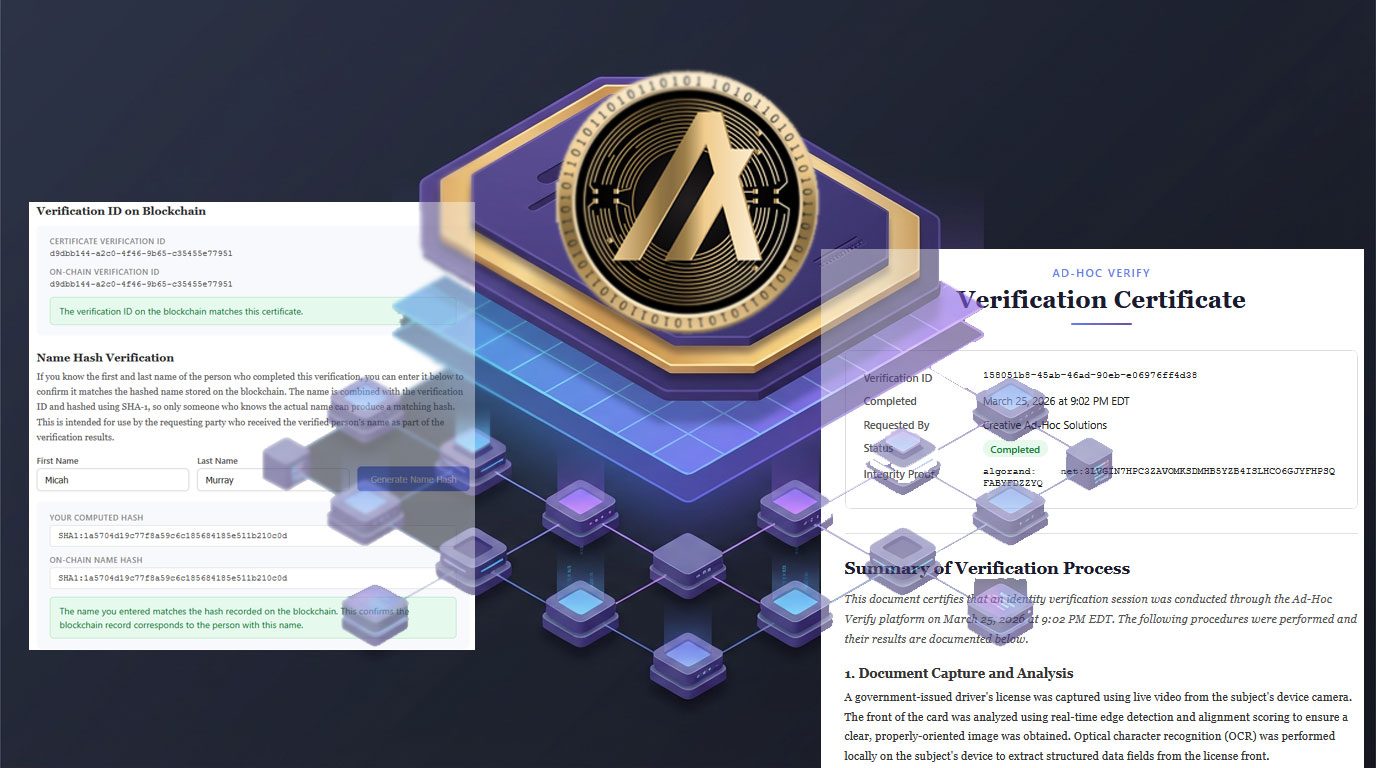
Shareable Certificate Permalink
Every completed verification lives at a permanent, shareable URL. Send it to counterparties, attach it to a contract, or file it with legal counsel as evidence that a thorough identity check was performed.
Anchored to the Blockchain
A cryptographic fingerprint of each result is published to a public distributed ledger. Even if our platform were to go offline, the attestation persists. Independently verifiable, forever.
Anonymized On-Chain
Nothing sensitive is written to the blockchain. The on-chain record contains only a one-way hash — enough to confirm that a specific verification matches a known person, but not enough to identify them or reconstruct any personal data.
"Reasonable effort" isn't just about running a check — it's about being able to prove you ran one.
Privacy First — And We Mean It
We're Not Building a CRM Out of Your Users' Data
Most identity verification services store photos, scans, and personal data — and that's not a bug, it's the product. A growing database of verified identities is their business model. We deliberately built ours to be the opposite.
What we never store:
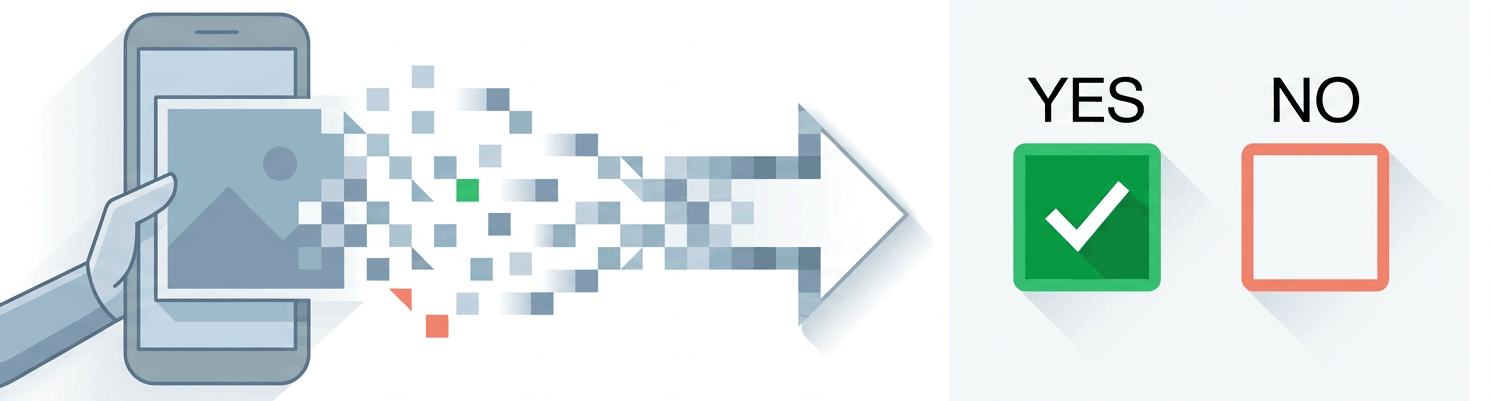
All face detection and comparison happens inside the user's browser, on their own device. Images are used only for in-browser face matching — never stored on our servers†. What we store is a result, not a face*·**.
When You Need Personal Data
Some verifications require collecting PII — name, date of birth, address. If you request those fields, they're encrypted before leaving the user's device‡ and automatically purged from our systems after your configured retention window. We don't mine it, sell it, or use it to train anything. It's yours, and then it's gone.
True End-to-End Encryption
For maximum privacy, supply your own RSA public key. PII is encrypted client-side with your key before it ever reaches our servers — meaning not even we can read it. Only you can decrypt it. Your data, your key, full stop.
Security That Doesn't Cut Corners
Built Seriously, Even for Small Use Cases
Just because you're not processing thousands of verifications a day doesn't mean your security should be compromised. Ad-Hoc Verify uses the same cryptographic standards as enterprise-grade systems — implemented by a developer who's been building web applications professionally since 2003.
Liveness Detection
Users must blink and turn their head to prove they're physically present. A printed photo or screen replay won't pass. Real-time passive liveness detection and corneal reflection analysis mititate spoofing attempts without adding friction for genuine users.
Anti-Tampering
Each verification session is protected by a one-time cryptographic nonce. Results can't be replayed or swapped. While results are calculated client-side, the nonce and session data are validated server-side to prevent tampering.
Bot Protection
Cloudflare Turnstile verifies each session is a real browser, not an automated script.
End-to-End Encryption
Personally identifiable information (PII) is encrypted client-side with your RSA public key before it ever reaches our servers‡.
Consent First
Users see exactly what data will be collected and must explicitly agree before the process begins.
Barcode Cross-Validation
The ID barcode data is compared against the printed front of the license for an additional layer of consistency checking.
Security was the design goal, not an afterthought.
Free to Start. Genuinely Low Cost.
Pricing That Doesn't Punish Small Teams
Free during beta. When pricing launches, plans start at $0/month with a generous free tier — and the full plan is just $10/month. No contracts, no minimums, no sales calls.